Showing posts with label Dainese. Show all posts

Tuesday, August 21, 2018

The Importance of Motorcycle Gear

The Importance of Motorcycle Gear

Looking cool on a motorcycle is one thing.  Being cool is quite another.

Joanna Benz only wears full motorcycle gear when riding
Story by Jim Foreman and Irv Seaver BMW

One look at this title probably has most “All-The-Gear-All-The-Time” or ATGATT zealots aroused at least as much as when ‘enjoying the stories’ (ahem) in the Sports Illustrated Swimsuit Edition.

This is not about ATGATT or repeating the mantra on social media posts like a brain-dead zombie. Instead, this is a discussion on why good quality motorcycle gear matters and why you should make a point to own some and use it.

The 2013 GEAR study made some startling conclusions including this one.  “A substantial proportion of motorcycle designed gloves (25.7%), jackets (29.7%) and pants (28.1%) were assessed to have failed due to material damage in the crash.”

This means that cheap, decorative, and poor quality moto gear is a waste of money.  As the old proverb goes, “Buy quality, and you buy it once.  Buy cheap and buy it several times.”  In other words, you get what you pay for.  Spend some money on quality gear.  It’s better to have one set of high-quality riding gear than a closet full of poor fitting, cheaply made kit that wouldn’t protect you in the most minor of incidents.

“Nothing turns me on more than a rider in a helmet and race suit.” –Laura Ruddy

Laura Ruddy
Fortunately, one can find bargains when premium clothing lines go on closeout to make way for newer styles.  Stick with top brands like Held, Dainese, BMW Motorrad, REV'IT, and Alpine Stars and you’ll be good.

If money is super tight, there are several local and online retailers selling pre-owned motorcycle gear.  It’s usually in excellent shape and can offer many years of service to the new owner.  The same premium brands mentioned above are often available.

Yes, it’s known that many of you that are reading this get it already.  If so, please share this story with someone who needs a nudge in the right direction.  If someone shared this with you, consider that person a true friend who thinks you’re smart and deserving of the best!

Let’s get past the obvious first. If you think riding in a t-shirt, sneakers, shorts, and maybe a helmet is all the motorcycle gear you need, this may be a long and painful journey for you.  At least you’ll meet lots of women… Mostly nurses, in hospitals.


Helmets


Starting from the top of your body down, a helmet is probably the most critical piece of safety gear you can wear.  It’s so crucial that many US States require helmet usage.  If one is trying to argue that they are better off in a motorcycle collision without a helmet, walk away.  They are completely full of it and probably also think they own Brooklyn Bridge.

Study after study concludes that helmet use offers the single most significant reduction in fatalities among motorcyclists.

What kind of helmet though?  In truth, a full-face helmet does the most to protect your brain and face in a collision.  They also are the quietest and keep bugs, rocks, rain, windshield washer fluid, cigarette butts, and other nasties off of your face while riding.  Whether it’s a solid full face or a modular helmet, these work the best in protecting the pilot and passenger.

Full-face helmets range in price from $79.00 at Cycle Gear to over $1000.  A surprising number of riders think the $79 helmet is perfectly fine.  It would be a wonder if they made any correlation as to what the helmet is protecting.

Yes friends, everything you are; your entire existence takes place in your brain and spinal cord.  Don’t you think it’s worth spending a little money to protect it with a high-quality properly fitted helmet?

This is all we are.  From the Bodies Exhibit
Yes, fitment is critical.  If it isn’t properly fitted, its effectiveness dwindles substantially.  Most people buy helmets that are too big for their head.  If it fits perfectly in the store, it will be too big in a couple of weeks.  It should fit snug, without pressure points.  Your cheeks may be pushed together like fish lips, but once it is broken in, it will fit perfectly and protect your head correctly.

The top makers of street helmets are Schuberth, Shoei, and Arai.  Time and time again, these brands have made helmets that offer comfort, quiet, airflow, and protection that is consistently proven effective.  That doesn’t mean brands like HJC, Shark, Nolan, AGV, and others aren’t good.  They are.  The key is that the helmet you choose fits your head in both size and shape properly and provides the comfort, airflow, aerodynamics, and quiet you want.

More importantly, it’s critical that you replace your helmet when it becomes too old.  For most brands, it’s 5 years from the date of manufacture.  Schuberth states you must discontinue use 8 years after the date of manufacture.  Every DOT helmet is required to have a Date of Manufacture label in the helmet.  Do you know yours?

Even if the helmet is never worn but kept in a cool, dark place, the EPS Liner (Styrofoam part that protects your head) degrades over time.  Like those cheap convenience store ice chests, it begins to harden and become brittle after some years.  With that, its protective capability quickly diminishes, too.

If your helmet is over 5 or 8 years old, it’s time to retire it and get a new one.

If your head has impacted the ground, however minimally, while wearing the helmet, you must retire it.  You may have just tipped over, in a parking spot, but if you hit your head, you must replace it regardless of whether or not it looks like it took damage.  Have you ever pushed your finger into one of those Styrofoam ice chests?  What happens?  Does it stay compressed or does it pop back out to normal?  That’s why they must be replaced.  The helmet did its job and protected your head.

Several helmet companies offer a significant discount if your helmet needs to be replaced after an impact.

If you buy a quality helmet, you will not have wasted your money on a stack of cheap helmets that may have looked super cool but doesn’t fit right, rattles, shakes your head, or suffocates you inside.

Armored Jacket


Mildred: “Hey, Johnny, what are you rebelling against?” Johnny: “What've you got?” -The Wild One

One can’t imagine a motorcycle rider without some type of jacket.  A jacket is so much more than a fashion statement, for most people.

A jacket serves to keep riders cool in the summer, warm in the winter, dry(ish) in the rain, and unscathed in a get-off.  Add to that the benefit of being free of bugs, insect stings, gravel, and errant cigarette butts.

Up until the early 90’s all one really had commonly available was a thick leather or denim jacket to accomplish this.  Now there are adventure, touring, racing, spirited-riding, commuting, bike show, cruising, cold-weather, warm-weather, electric, and even air-conditioned jackets.

Wait!  Wait! Some of you are thinking, is he crazy?  Wearing a jacket in the hot summer?  Yes!  Furthermore, the type of summer jacket one wears depends on if they are in a humid environment or a dry heat.
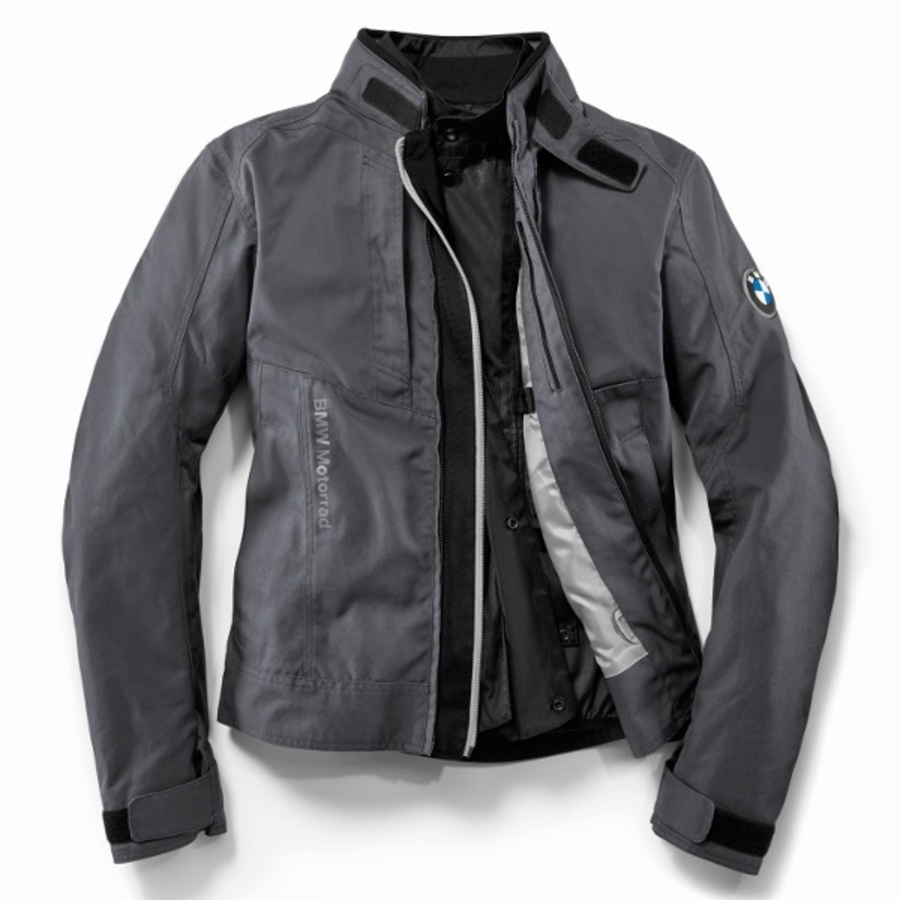
BMW Motorrad Boulder Jacket
If one is riding in a dry heat, a solid textile jacket with zipper vents like the BMW Motorrad Boulder Jacket works best.  Open the zippers enough to get the air circulating around your body and enable its natural cooling.   If too much air is passing through, one will dehydrate quite quickly as the body works overtime to produce a cooling sweat.  Remember, a body never evolved to travel at 65+ miles an hour.  It’s up to us to help our body do its job to keep our temperatures regulated.

Let’s say you’re in Virginia in July.  It’s humid!  A large-mesh textile jacket works quite well in those environments.

Either way, be sure to drink lots of water and stay hydrated.

Jackets do much more than regulating our temperature and keep us dry in the rain.  Most motorcycle jackets include CE rated armor in the elbows, shoulders, and often the back.

CE rated armor is explained quite well in this article by Motorcyclist Magazine.

On a get-off, a rider’s shoulder followed by the elbow is most likely to hit the ground hard.  Good armor is the difference between a little soreness and a hospital stay.

According to a March 2006 research study on motorcycle protective clothing, “Use of protective jackets and trousers, in particular, make riders significantly less likely to be admitted to hospital following a crash. Although (Protective Motorcycle Gear) often cannot prevent major injuries in high impact crashes; it can reduce torn ligaments, broken bones and gravel rash following minor crashes.”

Gloves


This one should be quite obvious.  The first time one gets hit with a bit of gravel or impacted by a suicidal bug usually drives home the point that gloves are quite necessary.

This is one of those areas where using a leather (Cowhide, Deer, Goat, Kangaroo) or other natural abrasion-resistant material seems to work best.


The best gloves have familiar labels.  Look for Held, BMW Motorrad, Dainese, and Alpine Stars.

Indeed, any glove is better than no glove, but imagine if the glove you’re wearing will protect the heel of your palm and fingers when sliding down asphalt or being pelted by hail, bugs, or gravel.

Additionally, a gauntlet style glove goes a long way to reducing wrist injuries versus hand only protection.

Pants


Now we come to pants.  According to the previously mentioned study, Legs are 74% likely to have an injury in a motorcycle crash.  The points with the highest severity are the knees and hips.

Bull-It SP 120 SR6 - Ladies Ocean Straight with Covec®
For many riders, the belief in the myth that legs aren’t as important as the rest of the body is foolhardy.  Clearly, these riders haven’t demolished their patella (knee cap) from an impact with the street.  Our legs make up nearly 50% of the skin coverage on our bodies. Naturally, our legs also give us mobility.  Since though there are no vital organs in our legs, it’s often given secondary priority for protection by motorcyclists.

Like with elbows and shoulders, modern rip-resistant fabrics like Kevlar®, Covec®, nylon and other incredibly strong synthetic fabrics go a long way to protecting our legs from abrasion.  Add CE rated armor to distribute any impact over a wider area and prevent serious injury to your knees and hips.

You don’t have to look like a spaceman to have protective pants.  Companies like Bull-It Jeans, Drayko, Dainese, and BMW Motorrad offer stylish, all-day comfortable jeans that disguise the protective features of the pants while still flattering your figure and fashion choices.

Sadly, denim jeans such as Levi’s, AE, Wrangler, or Diesel jeans don’t hold up in an abrasion.  Typical fashion denim jeans look great but are not designed, built, or intended to withstand abrasion. They last less than a second leaving you vulnerable, bare-skinned, and without critical knee protection.  Several companies, including Icon, make over-pant knee and shin guards that can offer significant added protection for a passenger or rider.

There’s no excuse not to wear protective pants.

Boots


Only second to one’s head, feet are the most common injury in motorcycle collisions.

Dainese Torque D1 Out Boots
According to the real-world GEAR study from 2013:  The risk of any foot or ankle injuries in a motorcycle collision was reduced 45% by wearing motorcycle specific boots and (a surprising) 53% by non-motorcycle boots when compared to shoes or joggers.

The conclusion was that any good fitting boots such as hiking, or work boots provide a risk reduction similar to motorcycle boots.

To their credit, motorcycle specific boots usually don’t have laces that can catch on levers or foot pegs when moving your feet to the ground, at a stop.  They also can offer significant protection
against sprains and abrasion.
“A rider wearing full motorcycle gear is practically invisible to me.” Trooper Worthington (Colorado State Patrol Motorcycle Trooper)

Summary

Nikki Riordan and Lyndsey Livingston always ride in full gear

The 2013 motorcycle apparel GEAR Study conclusively found the following to be true.
Motorcyclists wearing protective clothing fitted with body armor were significantly less likely to sustain injuries to the protected areas compared to those wearing non-motorcycle clothing.

Specifically, when body armor was fitted, there was a 23% lower risk of injury associated with motorcycle jackets, 45% for motorcycle gloves, 39% for motorcycle pants for leg injuries, and 57% by wearing motorcycle, sturdy work boots, or hiking boots.

This doesn’t mean you are protected by a shield of invincibility, but instead, you significantly increase your chances of being unhurt and uninjured in a motorcycle collision by wearing high-quality, proper-fitting motorcycle gear and equipment.

Fortunately getting high-quality gear has never been easier than it is now.  Visit your favorite retailer to try on and buy quality gear.  Ask about specials and closeouts and please, don’t buy gear just because it’s cheap or has cool colors.

When you’re in Southern California, or need a trusted source for the highest quality protective equipment and apparel, visit Irv Seaver Motorcycles in Orange County, California to try on and buy or order top-tier apparel from trusted brands including Schuberth, Held, Shoei, Arai, Drayko Jeans, Bull-It Jeans, and the incredible highly rated gear from BMW Motorrad.

Sunday, August 2, 2015

A Definitive Guide for Motorcycle Passengers

I am the passenger
And I ride and I ride
I ride through the city's backsides
I see the stars come out of the sky
Yeah, the bright and hollow sky
You know it looks so good tonight

The Passenger -Siouxsie and the Banshees

1923 BMW Series II R 32
Story by Jim Foreman.

Since the very first motorcycles were produced, one of the first accessories added was a passenger seat.

Inviting a passenger to ride with you is rather straightforward.  There is no limit of people who want to experience the excitement of riding a motorbike.  Many of those passengers are even going to be future motorcycle riders.   Others are content being the pillion.

There are three elements or responsibilities to successful riding with a passenger.  First is getting someone to ride with you.  Second is what the pilot needs to do to ensure a great experience.  Lastly, what the passenger must do to make for a safe and fun outing.

Getting Someone to Ride With You

2016 BMW R 1200 RS
For some, this is the easiest part.  As an attractive single man, a conversation with a woman will invariably include riding my motorcycle.  From there, it's a high probability that she will desire and even ask to take a ride with me.

Ask any 19-year-old who just bought a GSX-R or R6.  They’ll admit it’s to pick up girls.  It works until they crash a short time later.  Sadly, many young women are just as stupid as the young men who try to pick them up.  A beginner with a huge ego and libido on overdrive is not a promising start.  Add a 600 or 1000cc supersport, with no training, gear, license, or insurance and one easily sees a fast lane to disaster.  It’s important to note that not all 19-year-old riders do this.  Many do get proper training, license, insurance, and become excellent riders.
A very unwise combination

Many potential passengers have been brainwashed into believing that even standing near a motorcycle will result in possible death.  Other times, partners or significant others don’t share the enthusiasm you have for riding.  Lastly, there are those who simply don’t have the confidence that riding with you won’t lead to a crash or worse.

All of these rejections boil down to fear.  Sometimes that fear is rational and justified, other times not.    One example of justifiable concern is after twenty something years, you decide to go buy a motorcycle to relive your wild youthful days.  The last bit of training you had was your uncle saying, “Don’t crash, OK!”  Another source of rational fear and doubt is when you arrive and your bike is all scuffed up, you’ve been drinking, or you brag about recent crashes.

The irrational fear is something entirely different.  There are levels of irrational fear from mild to extreme.  If the fear is unrealistic, it’s best to smile and forget it, at least for now.  Be pleasant and ask kindly.  If the answer is no, just say, “Whenever you change your mind, I’d love to share this with you.”  Then without any sadness or disappointment, gear up and go for a great ride.  Do wave and smile as you ride off.

If it’s your partner or child, it important to never be negative and always express the fun and beauty you experienced.  Build in them a desire to want to ride without nagging.  Nagging never works, it just annoys the other person.

For those with only a mild fear, mention a recent training course you took and how much better a rider you’ve become.   A sure-fire motivator is a photo or stories of a recent trip where you experienced incredible and beautiful things.  In every case, it’s your calm, confident, and non-desperate demeanor that will have the most success.

Sometimes, with your child, the other parent may have, for any number of reasons, filled your son or daughter's head to not go riding with you.  For six years, my daughter would not ride with me.   One week before Father’s Day, I casually asked her if she’d like to ride and she said, “Yes.”  She immediately got a big hug and then proceeded to gear her up with an armored jacket, helmet, gloves and knee armor.

My daughter, excited about riding
We did a short back-road ride for about half an hour, and then, we came back home.  When she got off the bike, she was jumping and smiling and asking when we could go out again.  We’ve been riding together, ever since.

Initially, her mother was furious.  Adjectives hurled at me included childish, irresponsible, a bad example, and reckless.  My response was to send a couple of photos of our daughter all geared up and smiling big with a beautiful backdrop.  After the initial outburst, her mother has mellowed out and has not brought it up since.

Your Responsibilities as a Pilot

OK!  You were successful in arranging a passenger.  It is entirely within your power to make the ride a great and memorable experience or a terrible one.

Foremost, please have at least 1000 miles of safe, recent riding under your bum before you think about taking on a passenger.   Any less and one is really too inexperienced to handle themselves on a bike, yet alone a pillion.

A good start is to ask if they have a helmet.  Some will and this is a good sign.  If they don’t have a helmet, do NOT go into your garage and dig out the old, stinky helmet you used to wear with a scratched visor, and it’s lining falling apart.  Now, what about states that don’t require a helmet, you may ask.  Make sure you are both wearing a good DOT helmet, period.

For me, any passenger I take with me will wear a helmet, jacket, gloves, long pants and boots.  Hiking boots work well, and most people have them.
Good reason for a full-face helmet

If your passenger does not have a helmet and you do not have a new or very lightly used helmet that will properly fit, meet at Cycle Gear or a local store with a large selection of helmets.  HJC makes pretty good DOT certified helmets.  Often they are less than $100.00.  It’s not necessary or recommended to go out and buy a Schuberth or Shoei helmet for a first-time or occasional rider.  If your passenger becomes a regular rider, then certainly get the top-tier kit. 

A full-face helmet is highly recommended.  If there is a protest or a comment that the ‘party lid’ half-helmet is fine, suggest that bugs hitting one's face don’t taste or feel good.  If anything were ever to happen, you’d want their whole face and head protected.

In one instance, my passenger met me, at her door, holding her helmet but wearing short shorts, a baby-doll tee, and sandals.  She looked stunning, and I offered a pleasant kiss upon first seeing her.  I asked her if we could take a few photos to remember the day.  I put the motorbike on its center stand and had her sit in different poses, on the bike.  Her roommate was asked take some photos of us together both on and around the bike.  After the fun with the photographs, I calmly smiled and said, “That was a great idea dressing like that for photos.  Now, let’s get dressed for the ride.”  She hesitated for a brief second, smiled and said she’ll be back in a few moments.  When she reappeared, she looked incredible in jeans, jacket and hiking boots, and I told her so.  I even asked for another photo of us and the bike and one of us riding off together.

Many first-time pillions only understand being a passenger by watching movies, TV or notice women wearing skimpy outfits.  That's all they know, so they come to believe this is acceptable.  Without ever being negative, I say, “Yes, they do reveal a lot of skin.“ I express, “If anything were to happen, I want you to have the best chance of being uninjured.   Then I'll add that nothing looks more attractive than a woman in good riding gear.”  A quick browse to the Dainese or Held website women’s section will prove your point.
Dainese Woman

For the first ride, it’s imperative that it be short, fun, and interesting.  The first trip should last 30-60 minutes.   You want to leave your passenger asking for more rather than complaining that it was boring, or too long.   If your passenger is experienced, she'll probably have her own riding gear.  You both can decide, later, to extend the ride.  Stop for a break after a short time and ask how your passenger is doing.  Make sure they are comfortable and happy on the bike and with you as a pilot.

Before you take off, take a minute or two to tell your passenger what to expect.

First-time passengers hear these simple instructions when riding with me.
  1. Keep away from the muffler.  It’s hot and will burn quite quickly.
  2. Please ask before mounting or dismounting the motorcycle.  Do it as if mounting a horse.
  3. Indicate how you prefer they hold on.  I prefer they grip me so I know where they are and can feel what they are doing.  The ‘girlfriend’ holding your chest or waist, or ‘backpack’ is perfect.
  4. Look in the direction that we're going.  It will put you in a good position.
  5. Explain leaning and how they need to lean with you.
  6. Indicate some simple taps or signals to communicate, as it will be difficult to hear.
  7. Have Fun!

As the pilot, it’s critical that you don’t make the following mistakes with a passenger.
  1. Don’t ride like a jerk or show off.  Wheelies are a very bad idea!  Scaring your passenger will only get them not to like you and regret their decision to ever ride with you.  It will also guarantee any romantic intentions that might have existed will be lost forever.  Mellow out and ride a little slower than your solo-riding pace.  With a passenger, it will take longer to slow down.  The bike will also react differently than you are used to.  Be Smooth and your passenger will respond warmly.
  2. Don’t do an epic ride on the first or second outing.  Your passenger is likely not used to being on a bike for so long.
  3. It’s advisable not to ride with anyone else the first couple of times.  When there are others, egos tend to be fueled.  Riding with others will result in your passenger feeling awkward, at best and angry at worst.
  4. Don’t talk too much when you take a break.  Listen five times for every one time that you talk.  Your passenger will want to express how they feel.  Let them.  Don’t brag.  Simply and positively express how they’re doing and make simple corrective suggestions, if necessary.
  5. Don’t put ‘the moves’ on your passenger.  Even if you two are already romantically involved.  There is enough swirling through their head without the added nuisance.  If there is a romantic desire, pursue it at the conclusion of the ride.

Being an Excellent Passenger

Being a passenger on a motorcycle is a compliment and an honor.  Good riders don’t just take anyone on their bike.  Whether it’s your first time or your twentieth time, it’s important to recognize that every pilot is different.  It’s important for you to sync up with their unique riding style and be as neutral as possible.

Being an excellent passenger starts with having a great attitude.  If you’re not in a good mood and ready to have a great time, don’t do it.  You will be experiencing new and exciting sensations.  How you react will depend entirely on your mood.

Care about your safety.  Even if you’re not prompted to by the pilot, wear long jeans, a sturdy preferably leather jacket, hiking boots, gloves, and a Helmet.  Most of the time, the rider can help you with these items.  Don’t be afraid to visit Irv Seaver BMW or a gear store like the Dainese D-Store or Cycle Gear to pick up some moto apparel.  Remember, nothing looks more attractive than a passenger in well fitting riding gear.  Some riding gear is so stylish that people choose to wear it when just going out on the town.

Here are some ways you will be an excellent passenger.

  1. Listen to the pilot’s requests and follow their instructions.
  2. Don’t be afraid to ask questions.
  3. If the pilot grabs or taps your leg or hand it means you are doing a brilliant job, not that they’re trying to feel you up or get fresh.
  4. It’s OK to give the pilot a hug if you are happy or they completed a complex move well, in appreciation.
  5. Look in the direction you are traveling.  Keep your body close to the pilot and lean as they lean.  It may seem awkward at first, but it’s important.
  6. Try to use your feet and body to keep from putting too much weight on the pilot while braking.
  7. Be gracious.  At stops go in a buy both of you some water or a snack.
  8. Have Fun!

There are several key things that a passenger should not do or avoid.

  1. Don’t be a diva or complain.  Nobody likes that.  If you are too negative, you may find yourself taking a cab home.  As mentioned above, it’s preferable that you mention any concerns.  If the pilot is a jerk or not interested in what you have to say, arrange for your own ride home.
  2. Don’t make sudden moves.  The bike requires balance.  Any sudden moves can upset that balance.
  3. Don’t lean opposite of the pilot.  It will put added strain on the pilot and is more likely to cause the bike to crash.
  4. Don’t be a know-it-all.  It’s cool that your dad or uncle rode and blah, blah, blah.  You’ll be instantly ignored if you try to act like the smartest person in the room.  Yes talk and ask questions but don’t act like you have all the answers.
  5. Don’t forget to thank the pilot at the end of the ride.  If you’re inclined, offer to take the two of you out for a drink or meal in your car.

Reflections

Personally, Most every passenger experience has been great.  Everyone listened to my simple instructions, looked and leaned as I leaned and were exceptionally gracious after the ride.

On occasion it proved smart to wear my Oxford Riding Grips, a special belt with grab handles, to make it easier and more comfortable for my passenger.  Alternatively, some sportbikes have passenger handles mounted around the gas cap ring and they swear it works. Other options like Cycle Handles work well, too.

Several friends were invited to share their experiences being a passenger.  Here’s what they said.

Rocio Duran at the Korean Friendship Bell
Rocio Duran  –For years, Rocio’s mother would caution her against motorcycles.  It’s not uncommon for moms to do this even though their own experiences were probably positive when they were younger.
About two years ago, Rocio’s best friend, Nick Chan, also a rider, asked if she would like to go for a ride.  Rocio accepted.  Nick made sure Rocio knew about safety and gear and insisted that she wear a thick jacket, long pants, boots and a helmet.  He was able to provide a helmet for her to use.
The first trip was about an hour, and Rocio loved it very much.  Nick was an excellent pilot and made her feel safe.  They continued to take longer distance trips together for over a year.
When asked if there was any romantic intention with Nick, she said, they were and remain great friends, but no romance.
About the same time, Rocio began as a passenger, she also started attending bike nights with the Los Angeles Motorcycle Riders (LAMR).  Over the next few months, Rocio went and bought herself a helmet, armored jacket, gloves, and moto boots.
By the time all her moto gear was assembled, Rocio decided to take the MSF Basic Riders Course and get her license.  For the last six months, She has been riding a beautiful 2010 Kawasaki Ninja 250.  She rides primarily for commuting to and from work but is planning longer distance trips, for pleasure.
Recently we rode together, and she proved to be an excellent rider with a great attitude and sensibility.

Laura Ruddy in Rothenburg ob der Tauber
Laura Ruddy  -Laura and I became acquainted through the BMW MOA.  We are both on the younger end of the age spectrum, of the group, and shared many similar interests outside of motorcycling.  Laura is originally from Mesa Arizona but has lived in Germany for the last ten years.
Recently, on a visit stateside, we met up, and I took her out as a passenger four or five times.  I knew she was an experienced passenger, so longer trips were not a problem.  Laura owns her top-tier moto gear.

Instantly, Laura proved to be a riding muse.  She was like a $10,000 suspension job on my bike.  She would keep her petite frame light on the bike and lean, perfectly, into corners as I did.  Laura’s actions would settle the bike going into a corner and give me the added traction to take a more aggressive line.

After Laura’s stateside trip, She invited me to join her in Germany for three weeks.  Every day we rode through Bavaria, Germany, Switzerland, Austria, Italy, and Czech Republic.  Each time we would ride, our synchronicity would get better to the point where we knew exactly what we were thinking and how each of us was feeling based entirely on non-verbal communication.

(L-R) Sean Ruddy, Ian Ruddy, Laura Ruddy, and Jim Foreman
Many times, Sean, Laura’s husband, and her son Ian would also ride with us, on another bike.
Laura has evolved to become a 10 out of 10 pillion rider.  She can handle everything from a romp to the market or a day of laps at Nurburgring.  It’s reasonable to say I’m a better rider because of Laura Ruddy.

Though Laura has her ‘M’ endorsement and can ride, she prefers to be the passenger.  Lucky for me!

The things Laura loves, aside from Star Wars, her husband, and son, are motorcycles and a dunkel bier, and Germany.

Again, Many thanks to Irv Seaver BMW for their support of this blog.  Do stop in for the absolute best BMW Motorcycle deals, apparel, parts, and service anywhere in Southern California.

It would be wise to avoid riding with these kinds of riders.


Some inadvisable passenger riding techniques


Happy memories riding with a passenger
Gina Cardenas and Elaine Chang riding with the hero motorcycle cops of Santa Paula.

Jim Foreman and Laura Ruddy in Italy


Jim Foreman and daughter


©2015 words and photos Jim Foreman